

If you buy via hyperlinks on our website, we might earn a fee. Right here’s the way it works.
Some canine guard their prized possessions the way in which a toddler guards a favourite toy, besides this toddler has finished the maths, locked in eye contact, and is on alert to escalate emotionally. Initially, nothing dramatic occurs. No sound. Only a full-body pause that claims, I see you, and I would like in the event you reconsidered.
Sharing is at the moment underneath critical assessment.
In case your canine stiffens round meals, toys, or favourite areas, you’re not coping with stubbornness or dominance. You’re watching a stress response kick in — concern quietly activating inside protocols whereas the remainder of the physique goes nonetheless.
That’s useful resource guarding in canine. And for pups who guard, proximity issues greater than intent. In your canine’s thoughts, if entry may change, the interior assessment is already underway.
What Canine Really Guard (And Why The Record Retains Rising)
At its core, useful resource guarding is about entry. Canine shield issues that really feel precious, particularly when when free entry to them feels unsure. That half is regular.
What adjustments is how intensely a canine feels the necessity to shield their “asset.” Generally it’s predictable. Different occasions, it’s no matter they claimed 5 minutes in the past and have now determined issues deeply.
Generally guarded sources embody:
Meals and treats, particularly chews that take time and focus (typically known as “meals aggression”)
Toys, notably those that grew to become fascinating as soon as another person observed them
Resting spots, like couches, beds, sunny patches, or just lately occupied ground house
Discovered objects, like a sock that turns into invaluable the second you discover it’s lacking
Folks, typically one particular particular person, lap, or shared house
What hyperlinks all of those isn’t logic. It’s perceived entry. When one thing feels precious and doubtlessly in danger, useful resource guarding steps in to maintain that entry from altering.
Did You Know?Useful resource guarding is usually selective. A canine might guard one merchandise, in a single location, with one particular person, and be completely relaxed in every single place else.
Why Proximity Alone Can Set off A Response
For canine who useful resource guard, how shut you’re issues greater than what you propose to do. Somebody transferring nearer adjustments the image, even when nobody intends to the touch something.
Your canine isn’t weighing motives in that second. They’re noticing motion and recalling patterns. If closeness as soon as ended with one thing disappearing, proximity itself turns into significant. The mind flags it early, earlier than there’s time to kind out what’s really occurring.
That’s why the set off can really feel complicated. An individual strolling via the room. A toddler shifting place. One other pet passing by on the way in which to one thing else. None of it’s aimed on the canine, however all of it adjustments the state of affairs from their standpoint.
When entry feels unsure, ready to see the way it performs out isn’t an excellent technique. Responding early retains issues predictable — and from the canine’s perspective, predictable is security.
Early Indicators You’re Seeing Rigidity Construct
Useful resource guarding hardly ever begins with a growl. Most canine sign uneasiness earlier, typically in methods which are straightforward to overlook in the event you’re not on the lookout for them.
You may discover:
A sudden stillness when somebody enters the room
Arduous eye monitoring as an alternative of relaxed glances
Consuming sooner when individuals or pets transfer close by
Hovering over an merchandise or house
Delicate stiffening, particularly across the shoulders or jaw
Ears pinned barely again
These indicators present up when a canine is deciding whether or not proximity feels secure. The physique tightens first, lengthy earlier than the state of affairs turns apparent.
As a result of useful resource guarding can escalate to air snaps or bites, catching these indicators early issues. To not appropriate the canine, however to alter the setup earlier than rigidity escalates.
What Does Your Canine Guard?
Most canine don’t guard every part. They guard one factor at one time, for causes that make good sense to them.
The Pace-Up Eater – Calm till somebody walks by. Then it’s a race.
The Silent Hoverer – No growl. Simply extraordinarily deliberate physique placement.
The Sofa Claimer – Advantageous till somebody sits too shut.
The Opportunist – That sock was nugatory till you observed it.
The One-Individual Rule – Just one particular person’s lap is suitable, and it’s mine.

What Causes Useful resource Guarding In The First Place?
By this level, most house owners begin asking the identical query: why this canine, and why now?
Even well-socialized canine or those that’ve at all times had loads of “property” can guard. When it reveals up, it’s normally formed by a number of overlapping influences moderately than one single trigger.
UC Davis Veterinary Medication notes that aggression is usually misunderstood as dominance, when it’s extra generally pushed by concern, anxiousness, or possession — the identical substances that are inclined to gas useful resource guarding.
The elements that are inclined to matter most embody:
How precious the useful resource feelsFood typically tops the listing as a result of it’s tied to survival, however many canine guard chews, toys, resting spots, and even individuals simply as intensely.
What the canine has realized about accessGuarding isn’t at all times about shortage. It’s about what tends to occur when somebody comes shut. If entry has felt unpredictable previously, rigidity is sensible.
Stress within the backgroundA busy home, company, new pets, routine adjustments, or noise can all shrink a canine’s tolerance round valued objects.
Additional worth created with out realizing itThe sock you chase. The toy you hype up. The chew that’s at all times taken “for a second.” Consideration provides weight, even when it’s unintentional.
Particular person sensitivitySome canine are merely extra reactive round sources. That’s temperament, not a coaching failure.
Bodily or psychological depletionHunger, exhaustion, understimulation, or ache scale back flexibility and enhance the probability of guarding.
Any canine can develop useful resource guarding, no matter breed or background. What issues most is noticing the early warning indicators — and the way they’re dealt with as soon as they seem.
Why Punishing Warning Indicators Makes Guarding Worse
A growl, freeze, or sudden stiffness can really feel like the issue.
However these indicators are communication. Primarily, your canine is saying, I’m uncomfortable, and I’m making an attempt to deal with this with out it escalating. When a warning works, house will increase, and nothing else occurs. From the canine’s perspective, that’s a profitable final result.
Punishing these indicators adjustments the lesson. As a substitute of studying that communication retains issues predictable, the canine learns that discomfort reveals up with out warning. The strategy nonetheless feels dangerous, however the early indicators not really feel secure to make use of.
This isn’t a fringe concern. Veterinary behaviorists with the American Humane Society and lots of comparable organizations have lengthy cautioned that punishment can create fallout and worsen fear-based habits issues, notably when warnings are suppressed as an alternative of addressed.
That’s the place threat grows. The habits might look improved as a result of the growl disappears, however the concern doesn’t.
Did You Know?Animal behaviorists take into account growling and freezing as distance-increasing indicators — methods canine attempt to hold conditions from escalating with out utilizing drive.
Earlier than Coaching: Handle Your Pup’s Atmosphere
Earlier than you attempt to change how your canine feels a couple of useful resource, it helps to alter what they’re being requested to deal with. Administration isn’t avoidance or a delay. It’s the way you cease tense conditions from rehearsing themselves whereas every part else catches up.
Good administration lowers strain. When fewer moments really feel charged, each you and your canine have extra room to suppose moderately than react.
With individuals, that usually means:
Avoiding reaching into bowls, mouths, or resting areas
Giving bodily house whereas consuming or chewing
Setting clear family guidelines about who interacts and when
Utilizing gates or boundaries throughout high-value moments
Between canine, it normally means being proactive about setup — feeding individually, selecting up high-value objects, and creating resting areas that don’t require negotiation. The aim is to take away pointless strain.
Useful resource Guarding Coaching: How Change Really Occurs
As soon as issues really feel calmer everyday, coaching can lastly begin doing what it’s presupposed to do. This half isn’t about proving your canine will give issues up. It’s about serving to them really feel secure when entry adjustments, even briefly.
In the event you’re questioning what progress seems to be like, it’s normally refined. Fewer tense moments. Sooner restoration when one thing does really feel off. A canine who isn’t monitoring each motion the second one thing precious is concerned. These small shifts are normally the primary signal you’re headed in the best path.
When Guarding Is Directed At You Or Different Folks
When persons are a part of the guarding image, predictability issues greater than the rest. Canine settle after they be taught {that a} human’s strategy reliably results in good outcomes, and that letting go of one thing doesn’t imply it’s gone ceaselessly.
What tends to assist most:
Buying and selling as an alternative of taking, so your strategy doesn’t really feel like a menace
Strolling up, delivering one thing good, then leaving
Instructing drop or depart with out strain or urgency
Retaining interactions brief sufficient that rigidity by no means has time to construct
You’ll typically discover the change in physique language earlier than the rest. Much less stiffness. Simpler motion. A canine who stays engaged as an alternative of locking down an area.
How Desensitization & Counter-Conditioning Match In
On the coronary heart of this work is altering how your strategy feels to your canine. As a substitute of bracing for loss, they begin anticipating that one thing good may occur whenever you transfer nearer.
Just a few issues constantly matter:
Distance, so your canine stays snug
Timing, so good issues arrive earlier than rigidity reveals up
Worth, as a result of the reward has to matter greater than the fear
In case your canine begins consuming sooner, stiffening, or freezing, that’s normally an indication you’ve pushed a bit of too shut. Backing up isn’t failing. It’s a part of conserving the method working.
Veterinary Associate, a trusted useful resource written by veterinary professionals, describes useful resource guarding as a typical habits difficulty and explains that altering the emotional response — not testing tolerance — is what results in enchancment.
A Easy Desensitization Routine You Can Really Use
The aim with useful resource guarding is to alter what motion close by predicts in your canine’s thoughts. You need your strategy to begin which means, “one thing good is coming,” not “right here we go once more.”
Step 1: Decide A Deal with That Beats The Useful resource
Select one thing your canine loves greater than what they’re guarding. For many canine, comfortable and smelly wins. Assume tiny items of rooster, turkey, or sizzling canine. Hold parts small, so that you’re not creating a brand new drawback.
Step 2: Determine Your Canine’s “Too Shut” Distance
That is the purpose the place your canine begins to tense up. It could be:
Consuming sooner
Going nonetheless
Hovering more durable over the merchandise
Giving that mounted, watchful look
Some canine don’t care till you’re a few toes away. Others begin reacting whenever you’re merely within the room. You’re not judging it. You’re simply noticing the place the road is.
Fast instance: In case your canine quickens a refined warning signal whenever you’re three toes away, begin at 4 toes.
Step 3: Set It Up Like Regular
Give your canine the meal or chew they normally guard. Then stroll away such as you usually would. No hovering. No staring. Hold it boring.
Step 4: Method, Cease Early, And Toss The Deal with
Stroll towards your canine, however cease exterior that “too shut” distance. Toss one deal with. Once they end it, toss one other. Do this a number of occasions.
Then depart. Don’t linger. The sample you’re constructing is: strategy → great things seems → you allow.
Step 5: Repeat Throughout A number of Classes
Do that repeatedly when your canine has the useful resource. You’re not on the lookout for a dramatic response. You’re on the lookout for a canine who stays looser as a result of they’re beginning to anticipate the deal with.
Step 6: Shrink The Distance Slowly
After a number of profitable classes, take one additional step nearer, toss the deal with, then step again and depart. That’s it. One step is a lot.
In case your canine will get tense, you went too quick. Again as much as the final distance the place they stayed relaxed and rebuild from there. The quickest strategy to progress is to maintain the canine underneath threshold.
How Do You Know This Is Working?
Progress with useful resource guarding is refined at first. You’re not on the lookout for enthusiasm or compliance. You’re looking forward to ease.
Indicators issues are transferring in the best path:
Your canine retains consuming (or taking part in) at a traditional tempo whenever you strategy
Physique rigidity softens as an alternative of accelerating
They look up briefly, then return to what they’re doing
The space the place guarding reveals up slowly shrinks over time
In the event you’re seeing these adjustments, even inconsistently, the emotional response is shifting. That’s the half that issues most.
When Guarding Happens Between Canine
Between canine, coaching seems to be a bit of totally different. This isn’t about instructing them to share. It’s about decreasing competitors and eradicating the sensation that they should handle the state of affairs themselves.
What normally helps:
Stopping unsupervised entry to high-value objects
Rewarding canine for selecting distance
Reinforcing calm disengagement
Retaining routines predictable so entry doesn’t really feel random
When this works, issues don’t look dramatic. They only really feel calmer. The canine cease treating these moments like they’re on their very own.
What Not To Do Throughout Coaching
Most coaching doesn’t collapse throughout deliberate classes. It unravels within the on a regular basis moments that really feel innocent as a result of nothing went incorrect final time.
Widespread slip-ups embody:
Reaching in “simply to test”
Taking one thing and not using a commerce since you’re in a rush
Being constant more often than not, however not all of it
Letting new individuals or pets work together with out setup
Ignoring stiffness as a result of there was no growl
These moments train your canine that predictability comes and goes. When that occurs, outdated guarding habits are inclined to creep again in.
Useful Coaching Expertise For Canine Who Useful resource Guard
These obedience expertise don’t “repair” useful resource guarding on their very own. What they do is offer you safer choices in on a regular basis moments, so that you’re not counting on reaching in, crowding your canine, or pushing via rigidity.
Consider them as pressure-reducers. They create house when issues may in any other case get uncomfortable.
1. Drop It & Depart It
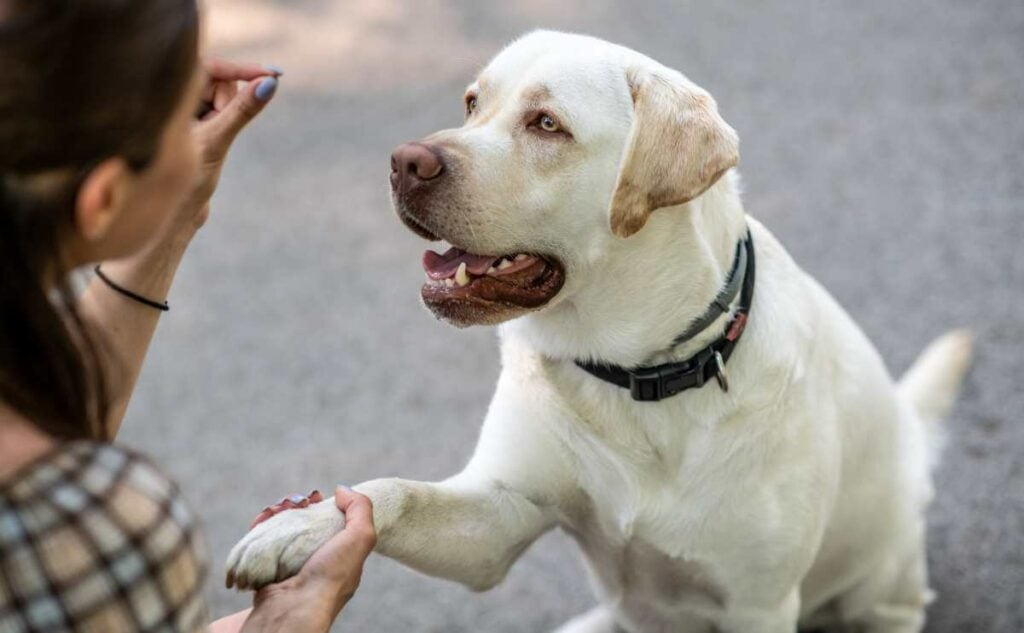
Each cues matter, particularly for canine who guard. Drop it asks your canine to let go of one thing they have already got. Depart it asks them to disengage earlier than possession even occurs.
The secret’s the way you apply them.
Begin with low-value objects. Toys are normally simpler than meals. When your canine drops one thing, instantly comply with it with a reward that’s clearly higher. The message you’re constructing is straightforward: letting go doesn’t imply shedding out.
As your canine will get snug, you possibly can work as much as higher-value trades. In the event that they drop a primary chew and get one thing higher in return, you’re reinforcing the concept cooperation pays off. That expectation carries over when guarding is a part of the image.
With depart it, the aim isn’t perfection. It’s instructing your canine that turning away from one thing might be simply as rewarding as getting it. Equal or higher-value rewards make that lesson land sooner.
2. Come When Known as
A strong recall provides you an possibility that doesn’t contain approaching your canine after they’re guarding one thing. That alone can decrease threat.
As a substitute of strolling towards a chew toy or meals bowl, you possibly can name your canine away from it. That shift issues. It retains distance in play and avoids turning the strategy right into a set off.
Recall coaching works finest when it’s first practiced away from guarding conditions. Construct it in calm, low-pressure moments. When it’s dependable, it turns into a precious device.
3. Go To Place
In case your canine guards a particular spot, just like the sofa or your mattress, a go-to-place cue is usually a game-changer. It provides your canine a transparent various that doesn’t contain bodily steerage.
This works finest when the designated spot is genuinely snug and predictable. You’re not sending your canine away as a punishment. You’re giving them a spot the place they received’t be disturbed.
Having this habits on cue means you don’t have to crowd your canine or push them off an area. That retains everybody safer and reduces the probabilities of guarding being rehearsed once more.
When It’s Time To Get Skilled Assist
Some conditions transfer past what cautious administration and primary coaching can safely deal with. Figuring out when to herald assist isn’t about giving up. It’s about recognizing threat.
Additional assist issues most when:
There have been bites or shut calls
Guarding escalates rapidly or with out warning
Kids or weak pets are a part of the family
Administration alone isn’t stopping tense moments
A great skilled helps sluggish issues down, spot particulars you may miss, and information adjustments with out growing threat. That sort of assist typically prevents larger issues later.
How To Discover The Proper Skilled
Not all trainers are geared up to work with useful resource guarding, and the distinction issues. As a result of guarding is pushed by concern and uncertainty, strategies that depend on punishment, intimidation, or “proofing” could make the habits worse, even when they appear to quiet it briefly.
If you’re on the lookout for assist, prioritize professionals who:
Give attention to habits change, not compliance
Use constructive reinforcement and habits modification
Are snug working under threshold, not pushing via warnings
Can clarify why they’re doing one thing, not simply what to do
If in-person assist isn’t accessible or inexpensive, otherwise you wish to be taught at your individual tempo, on-line coaching might be a wonderful possibility. We’ve reviewed and in contrast common applications in our information to the most effective on-line canine coaching programs, together with what to search for, what to keep away from, and which approaches are acceptable for habits points like useful resource guarding.
Continuously Requested Questions
Pup house owners have a whole lot of questions on useful resource guarding, and listed below are a number of the most typical we see. If in case you have different questions, don’t hesitate to ask us within the feedback.
Is Useful resource Guarding A Signal Of Aggression?
Not at all times. Useful resource guarding is about defending entry, not searching for battle. Aggression is the device a canine might use if earlier indicators don’t work, however the motivation is normally defensive moderately than hostile.
Can A Canine Guard From One Individual However Not Others?
Sure. Canine monitor patterns intently. Guarding typically reveals up with particular individuals, actions, or routines that really feel much less predictable to the canine.
Does Useful resource Guarding Imply My Canine Doesn’t Belief Me?
Not essentially. Guarding typically displays uncertainty round outcomes, not the standard of the connection as an entire. Many canine who guard are in any other case deeply bonded to their house owners.
Will Coaching Ever Make My Canine Cease Guarding Fully?
It is dependent upon the canine. For some canine, the habits fades into the background. For others, it turns into manageable and predictable moderately than fully gone. Progress is measured by security and emotional ease, not perfection.
Ought to I Take away All Excessive-Worth Objects To Stop Guarding?
Quick-term administration may also help, however long-term avoidance doesn’t change how a canine feels. The aim is structured entry, not everlasting restriction.
When Useful resource Guarding Isn’t The Solely Factor Going On
Useful resource guarding hardly ever exists in isolation. It typically reveals up alongside stress, communication gaps, or conditions the place canine are requested to manage with out sufficient readability or house.
In the event you’re seeing guarding behaviors, these guides may also help you zoom out and spot patterns that aren’t at all times apparent within the second.
Which conditions are inclined to set off guarding in your house, and when do you discover your canine stress-free once more on their very own? Share what you’re seeing within the feedback. Your expertise might assist one other canine proprietor join the dots sooner.


